
Our new tool to explore opportunities to reduce hospital care helps systems identify the types of hospital activity they can target to deliver the left shift.
It helps systems to answer three important questions:
- Where are the opportunities to reduce hospital care?
- Which hospital care might be avoided or transferred into community settings?
- Where are the opportunities to shift care into the community?
These insights help commissioners, providers and system leaders confidently develop strategies to make these opportunities a reality.
Who is the tool for?
This tool is designed primarily for healthcare analysts supporting senior decision-makers within and across organisations and health and care systems. It provides evidence to support system planning for reducing hospital care and shifting care into community settings.
The tool provides essential insights for:
- Integrated Care Board commissioners
- Providers across health and care systems
- Operational leads and those with strategic oversight of neighbourhood health delivery.
Delivering the 10 Year Health Plan
The 10 Year Plan sets an ambition to reduce reliance on hospitals and deliver care closer to where people live. But which forms of hospital care might be avoided or transferred into community settings? And how much hospital activity can be avoided?
The tool draws on our award winning work for the New Hospitals Programme and the Intelligence Centre for the National Neighbourhood Health Implementation Programme.
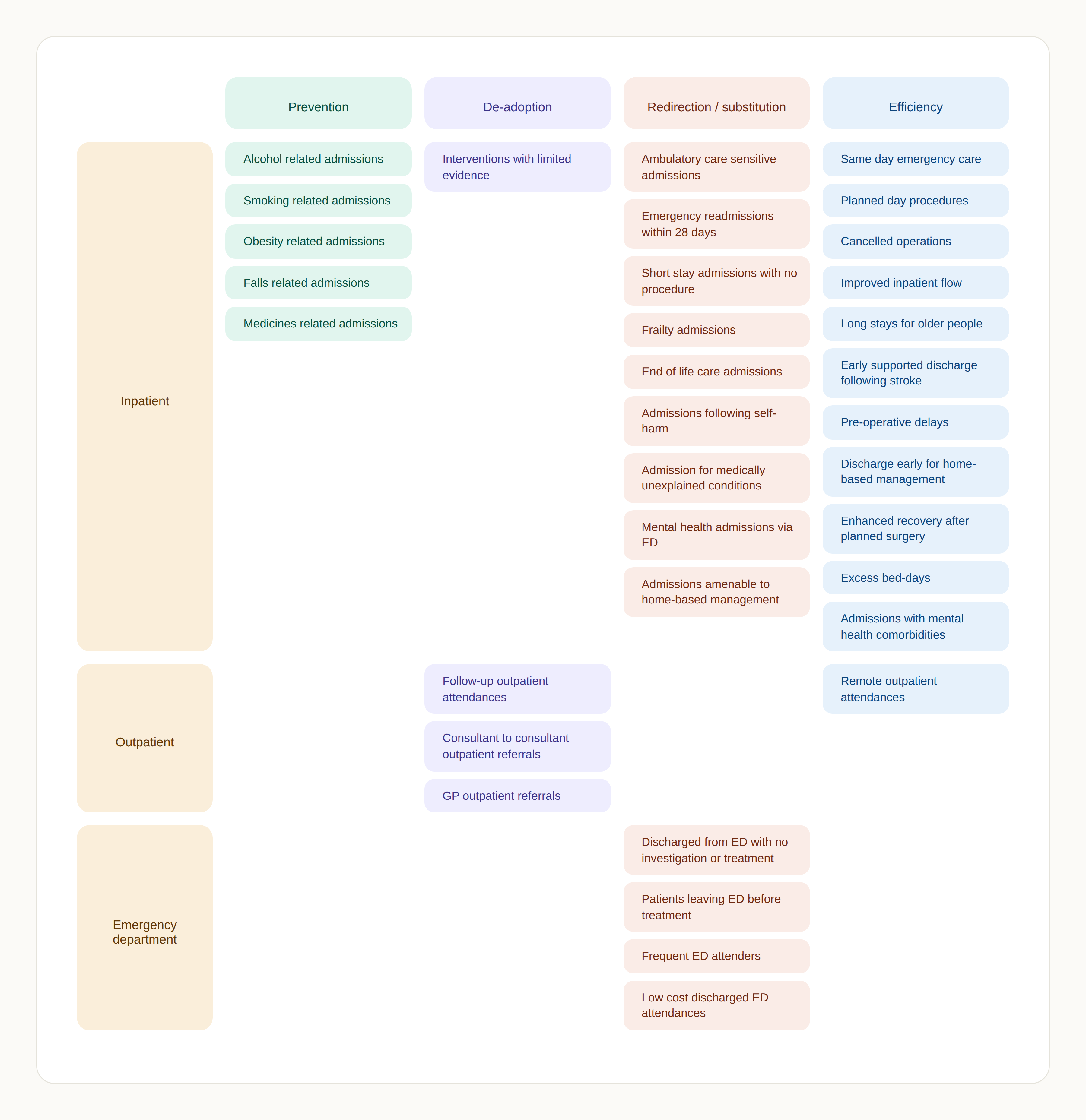
By reviewing the evidence, talking to clinicians, and analysing data, we have identified 34 ‘types of potentially mitigable hospital activity’ (TPMAs). These include care delivered in inpatient wards, outpatient clinics, and emergency departments. Activity can be mitigated through four mechanisms:
- Prevention – acting upstream to improve people's health and manage their health risks
- De-adoption – stop providing treatments that are unlikely to benefit patients
- Redirection/substitution – delivering care in the same or a different form in the community
- Efficiency – improving the way care in hospitals is delivered to reduce the time that patients spend there.
Together, these mechanisms provide a practical framework for understanding where different approaches can reduce demand for hospital services.
How can I use the tool?
Using the tool analysts can:
- Explore the volume of potentially mitigatable hospital activity;
- Examine trends; and
- Identify geographical variation.
By its very definition, the volume of ‘potentially mitigable’ activity is large. We don’t therefore suggest that all the activity identified by the tool can or should be avoided: only a proportion of it can be. Instead, analysts can use the tool to provide an evidence-based place to start planning and prioritisation. Local context, clinical judgement and service capacity will determine what is achievable.
You can work with your analysts to understand and assess the scale of the opportunities and challenges you face as you tackle the care shift agenda and work to secure the benefits this offers for patients.
Your feedback is valued
This tool is in continuous development, and we welcome your feedback. Use the ‘Give Feedback’ link in the top-right corner in the tool to tell us what’s working, suggest improvements or different features. We are also working on enhancements to make it easier for non-analysts to use, so keep a look out for that in the coming months.
If you have questions about the tool, its methodology, or how it can support planning in your organisation, please contact katie.spanjers1@nhs.net
Access the ‘Explore Opportunities to Reduce Hospital Care’ tool.