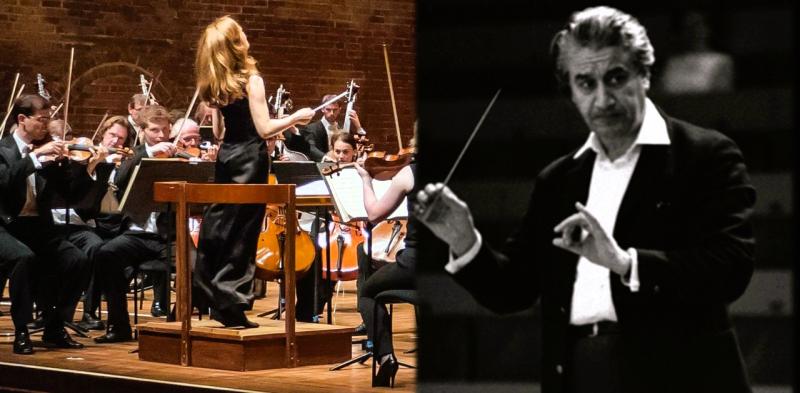
Two famous conductors of symphony orchestras: Sergiu Celibidache and Mirga Grazinyte-Tyla. What do you see? Magnetism? Motivation? Energy? Passion? Communication? Control? Focus?
I have recently been interviewing leaders across the NHS and its partners about how they envisage Integrated Care Boards (ICBs), given the remit set out in the 10 Year Plan. We ask them what – if anything - they need of an ICB to be able to deliver their own mission. What can only the ICB do? How should the ICB operate? What skills and capabilities would it need?
Interviewees often used an ‘orchestral conductor analogy’. They see an ICB as being like a conductor in that they are trying to help a group work in an aligned way.
But sometimes the way they unpack the analogy suggests they are, well, fuzzy about the details. As a keen musician, and with a professional orchestral player in the family, I thought it might be interesting (and fun) to explore this analogy. Maybe there is something illuminating here.
If we think that ICBs need to be the ‘conductors’ of their system, then let’s provoke ourselves by considering, in a little detail, what it takes to be a conductor of an orchestra.
Setting the scene, knowing the score
The ‘conductor analogy’ gets into immediate difficulties. Everyone in an orchestra has the same piece of music on their stands (rather their ‘part’ in the same music); they all have it the right way up; they all start from the same place, and they finish at the same point. The ICB, however, has to debate and agree what to play before it can determine how to play it.
The conductor also has the ‘score’ (see below). This contains all the parts - defined sequenced and integrated - including any instructions provided by the composer. The part for the cymbal player, for example, might be largely full of rests (counting time when nothing is to be played). It then includes a few big moments when their contribution is critical.
The issue at hand for the conductor isn’t what to play, it’s how. The music being played was written by a composer, who is very often long dead and cannot be asked for clarification. Other than in exceptional circumstances, what the composer wrote isn’t up for debate. The score is the undisputed primary source for the performance.
From this perspective, maybe the analogy with NHS commissioning looks somewhat thin?
| Figure 1a is a page from the printed score of the fourth movement of Mahler’s ‘Das Lied von der Erde’. Each line (stave) shows what the various instrumental groups are playing, and a vertical view shows how they align. Each player will have a part to play from showing just their notes, plus maybe a few cues to help them coordinate with other. The conductor works from the score and is agreed by all to ‘own’ it when rehearsing and performing. The score is the primary source for the performance, though there can be extra levels of detail to debate -such as various editions published over time which have reached subtly different conclusions based on the real primary source, which is the composers usually hand-written, and at times scrawling, manuscript (see figure 1b). |
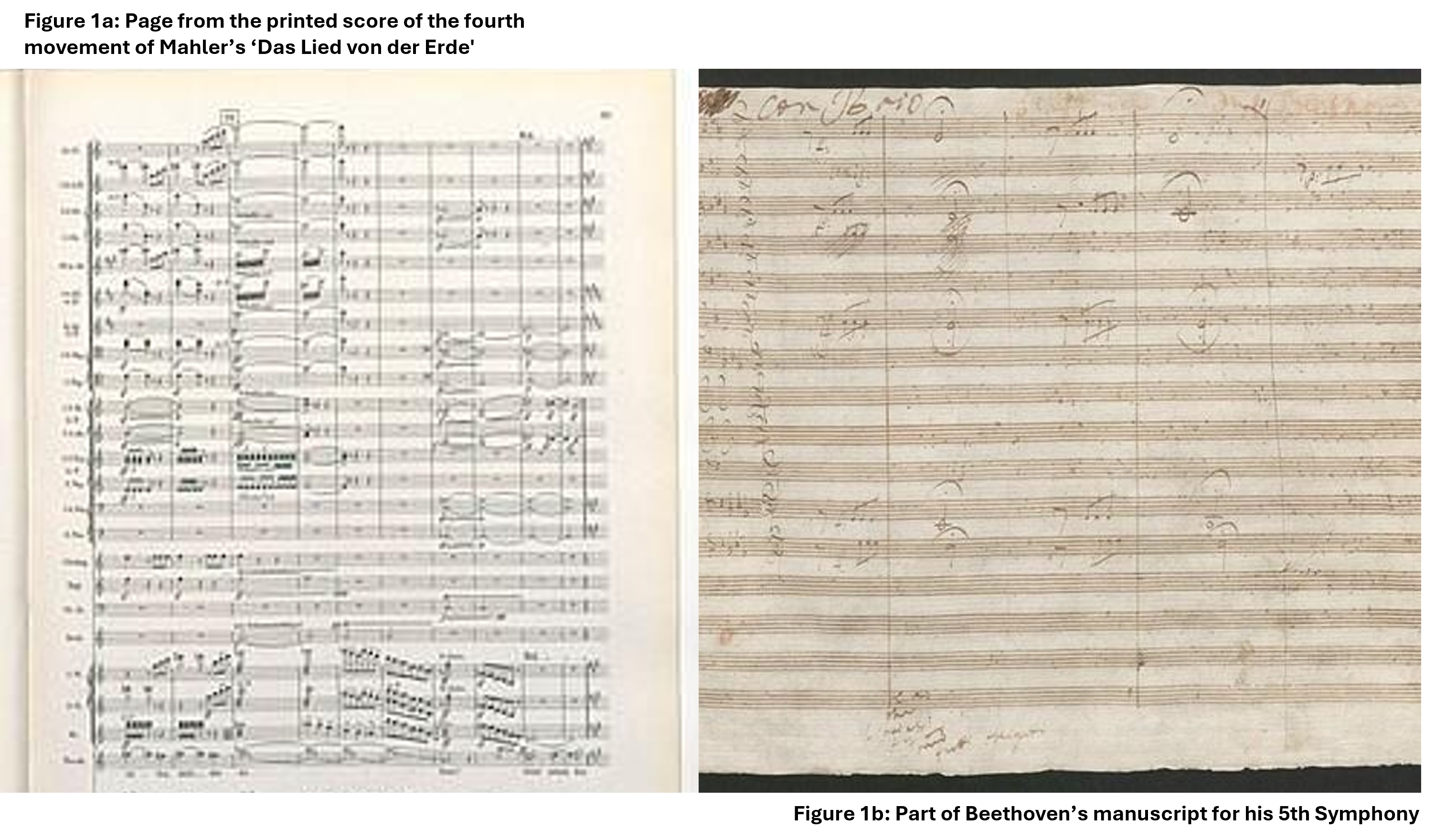
NHS readers can reflect on which of these images best represents their plans!
Maybe the analogy gets stronger when we consider that the choice of what music is played is made by others. This may involve the conductor - if they are also appointed as ‘artistic director’ - but more often this decision is made by orchestral management, concert promoters, broadcasters or record company executives. Their main aim is to attract a paying audience. (The orchestra cares about this as well, but they attach equal importance to their artistic reputation and musical integrity). Once the audience is there, though, it is for the conductor – working with the players - to deliver a performance that fulfils expectations.
Other critical points to realise, before we delve further into the conductor’s role, include:
- In a typical professional orchestra, there may be 80-120 players. Each of them is a master of their instrument and their part. They are ‘10000 hours’ professionals. They do NOT need the conductor to give advice or to prescribe the mechanics of their craft.
- Very often, the players will have strong views on how a piece should be played. Many, when away from the orchestra, play as soloists, do recitals, teach, etc. They will have played the piece far more times than the conductor has conducted it. The conductor has to convince them all to go with his/her conception of the piece: even if it is very different to each player’s conception. Egos may occasionally get involved.
- It is not only the conductor that guides the performance. Orchestras have a Leader –sitting at the front of the violins – who, through extra bow and bodily movements, gives considerable information to aid cohesion. And the Principals of each section, the flutes or the horns for example, are always taking cues from each other and giving them to others. Musicians have excellent peripheral vision as well as acute hearing. In a loud concert in a difficult hall, the players at the back of sections struggle to hear themselves let alone other players. It is surprising how often their coordination comes through visual cues from colleagues as well as the conductor. The audience may focus on the conductor, but distributed leadership is a critical feature of professional orchestral performance.
- For quite a lot of the repertoire, the orchestra could play the piece pretty well without a conductor. In practical terms, the need for a conductor increases with the complexity of the music, and the extent to which it requires coordination and unanimity across multiple speed changes, etc.
- A conductor will often join the orchestra as a ‘guest’. They may have never worked with this orchestra before. And, conducting being an international business, they may have to do so in what is their second, third or fourth language. Time may be tight: they may have just days to rehearse before performing.
- Judgement and tradition matter. There are an endless variety of ways to play a piece of music. There is no ‘right way’, but there is a ‘rightness’. Music enthusiasts can love the very different interpretations that conductors bring to the same piece of music. Indeed, they value the differences: if delivered with conviction and with respect to the composer. Some performances of great works recorded over 100 years ago are still treasured because of their unique spirit. There is a canon to musical performance. Conductors and players see themselves as part of a tradition. Audiences do too. A conductor who doesn’t understand what they are doing in the context of what went before, and what may yet come, would soon fail.
So, the conductor has to earn their place by doing rather subtle things, brilliantly. They have to do so in a way that carries the respect of the orchestra if they are to have any positive effect. Sometimes, they need to earn that respect very quickly in a new relationship with a hard deadline. In the past, conductors often did this through fear. There were famous orchestral tyrants with reputations that could reduce players to jelly. This is now out of fashion. Today, it is collaborators that are rising to the top.
How does the analogy with NHS commissioning look now?
The job and the skills
It is surprisingly difficult for a non-musician to see what a conductor does. Some elements of the role are visible and tangible. For example: they start and end the concert (or rehearsal / recording session) on time; they give the beat and indicate the dynamics required through body language; and they correct internal balance between sections of the orchestra.
But the role also involves the invisible and intangible. Conductors ‘inspire’ and ‘interpret’, for example. To bring this into view, here are a few descriptions of the conductor’s role. The important but subjective elements are italicised:
- Being an artistic leader and musical guide, whose authority flows from respect commanded by their exceptional musicality, knowledge of the score and its context and excellent communication.
- Shaping the interpretation through persuasion and technique. Unifying the orchestra, coordinating its actions. Setting key elements such as tempo and balance. Managing the rehearsals effectively; being the focal point for inspiring a performance in the concert.
- Resisting unhelpful group dynamics (a tendency to collectively speed up, for example) in the interests of achieving the overall mission of a fine performance.
- Being the most attentive and effective listener, with the ability to take corrective actions to help the collective be greater than the sum of its parts.
- Providing vision; technique; inspiration; connection with the audience
In more practical terms, how does a conductor do this? What are the skills required?
The following lists the essential skills of a good conductor. A great conductor has these skills, plus the less tangible elements. Greatness doesn’t come from an especially refined baton technique or memorising every last note in the entire score: it comes from the ‘rightness’ and individuality of interpretation, the ability to guide players to this through communication and inspiration, helping audiences to believe in that.
Embodying the context
- The conductor must have encyclopaedic knowledge of the entire musical repertoire. This means musical history, plus the wider artistic context for the work. Often, what the conductor needs to communicate about performance intentions will come from: knowledge of the personal and political circumstances in which the piece of music was conceived; the rest of the composer’s output and where this piece sits within that; and the painting, poem or works of another composer that may have inspired it.
Performance
- Performance brings mental and physical stresses for the orchestra. These can be extreme, and only really understood through personal experience. The conductor must know what it is to perform on one or more instruments, in public, at the highest levels.
- Deep knowledge of musical performance practice (how to set about accompanying a soloist and how to manage oneself on stage for example).
- The ability to combine attention to detail with a clear sense of the whole, shaping an exciting or moving performance.
- Knowing how to inspire the orchestra to rise to a performance, given the challenges that stresses and adrenalin bring. This includes the ability to take risks in performance without tripping everyone else up.
Technical musicianship
- The conductor should have a good working knowledge of how to play every instrument in the orchestra, knowing the art of the possible for each. For example: how does breathing effect what a trumpet player can do? What therefore does the conductor need to do to assist?
- Practical experience of musical composition and of the creative process.
- Advanced musical analysis and translation of that into artistic interpretation.
- Mastery of styles of performance, grounded in deep historical knowledge and awareness of performing traditions over time.
- Total mastery of the language of music: ways in which music can be written down, and the technical language used by composers and performers to describe what and how to do things. Describing a required sound to violinists, for example, often needs the language of bowing techniques.
Conducting technique
- ‘Baton technique’ (though some conductors eschew an actual baton and use hand gestures). This requires the technical discipline of how to communicate pulse, phrasing and rhythm through a technical language of hand and arm movements.
- Rehearsals are strictly controlled. They start and end on the dot, irrespective of what the conductor wants. And they are limited in number. It will be very rare for a conductor to have more than two days rehearsal for a concert involving two hours of music. Rehearsal technique matters: and wasting time is a cardinal sin!
- Podium presence is hard to define, but easy to spot. An effective conductor inspires attention through personal magnetism. It can be quiet. It can be extrovert. But, without it, no spark will be achieved. Rising to performance requires collective belief and commitment; the conductor has to inspire that personally.
- Communication is both verbal and physical. Rehearsal time may be spent achieving a particular effect that often requires the conductor to explain what they want and why. But this will come to little if they can’t also express that physically. In the heat of performance, the only option is communication by gesture or facial expression.
- The conductor may be working with an orchestra that speaks a different language to their own; they need to coach singers who are not singing in their mother tongue; they need to be able to understand the instructions in musical scores that are written in many languages.
- Achieving respect of the players by leading through example in terms of: creativity (striving for new understanding and insight); knowledge (knowing the score and the compositional processes that underpin it); and dedication (to delivering the best possible presentation of the composer’s intentions in a way that gives the greatest artistic experience to the audience).
- Vitality and curiosity. Otto Klemperer was one of the greatest conductors of all, with a towering reputation for his performances of Beethoven’s symphonies. In a long life, he performed many of these works over a hundred times. But the musicians he worked with described how on the first day of the rehearsal he was to be found studying the score afresh, reconsidering every element of his approach to a work he knew probably better than just about anybody.
Commissioners as conductors?
Delivering a great orchestral performance of a symphony by Shostakovich with 120 disparate musicians is patently a world apart from an ICB working with its system to address health inequalities. But, with some creative license, are there parallels that offer food for thought?
Perhaps one place to start is when not to act. A conductor who does too much is likely to be more damaging than one who does too little (remember: an orchestra can get through most works without them). Great conducting involves brilliance in what are often subjective or intangible areas - where using persuasion and communication to secure belief and commitment are the tools of the trade.
Then there is the nature of the relationship. The conductor-orchestra relationship is a kind of pact. Often an explicit one. The players cede a certain authority to the conductor to achieve a better overall result. They do so out of respect to the composer, the audience, their collective tradition and their professional pride as a performer.
Within that area of authority, the players will accept being told to do things differently. If the conductor asks them to play quieter or slower, they will accept that judgement rather than argue their position. In return, the conductor needs two essential foundations: to know what they are talking about, in terms that the professionals they are working with understand; and to be expert in their own craft.
And then, to make the essential difference – and to make the pact feel good and right for both players and audience alike - they have to bring something extra: the ability to rise to a performance through well-communicated and genuine inspiration and commitment. That is where it becomes artistry. Is this taking the analogy too far?
Then there is feedback. After any performance, it is common practice for every player to be invited to submit an assessment of the conductor. And there is also an army of professional critics. They publish reviews of the concert or recording, sometimes with stinging vitriol. And whilst the audience generally starts out wanting a good time - and so positively inclined to the conductor - there is a tight-rope about performance that can be very exposing indeed. Their feedback comes in various ways, including via the wallet.
Finally, there were a few titbits in the analogy that point towards ways of working – subtle and explicit - for commissioners. For example, the:
- discipline of managing time in rehearsals.
- need for proficiency in many ‘languages’.
- notion of respect being earned through deep knowledge and appreciation of the lineage.
- fact that there is no one right performance, but there are performances that communicate ‘rightness’ as a result of their internal cohesion and the conviction of delivery by all.
These are perhaps worth further reflection.
The orchestral conductor analogy for ICBs is by no means perfect. But it is at least enjoyable. There are so many essential differences. Yet both are leadership roles that require a blend of the technical and intangible.
I have not sought to overburden the analogy by drawing out a set of contrived conclusions. Instead, I hoped that it prompts lines of thinking that the reader might find useful.
Acknowledgements: thanks to Zoe Beyers, Leader of both the BBC Philharmonic Orchestra and Britten Sinfonia, for advising on the technical musical content.