
Ara Darzi, Wes Streeting and English health policy. Part 2: cutting the knot
Following on from part one, Fraser continues exploring the Gordian Knot of English health policy.

Ara Darzi, Wes Streeting and English health policy. Part 1: the Gordian Knot
Health policy is not at a crossroads, it is in a bind. Strands so entangled, so complex they resemble a Gordian knot. Can this knot be untied?

The risks of risk stratification
Medical history is full of bizarre and gruesome procedures.

Want to ease pressure in urgent care? Simply cut community services!?!
What should decision makers do with analysis that challenges deeply held assumptions? In this blog, Fraser Battye reflects on a surprising recent finding about community services.


MDSN: Community Healthcare Services
How Does Access to Community Health Services Vary Across the Midlands?

Ghosted by an old friend
“…personal contact was a vital element in general practice from the beginning. By 1959 50% of people in England regarded their GP as a personal friend.”

Part-time GPs and the decline in continuity of care: a cause or a symptom?
In our recent paper we explore why levels of care continuity have been declining and what might be done to turn things around.

Two sides of the same coin
Hospital demand arising from GPs not seeing patients, is eating into the resources that they would use to manage down the elective backlog. In turn, this is creating more demand for GPs.

Are GP consultation rates rising or falling? Who or what should we believe?
If the "data suggests" GP appointments are substantially higher than pre-pandemic, then what is behind patients reporting recieving fewer appointments?

GP services: new analysis and fresh insights
In our latest analysis for the Midlands Decision Support Network (MDSN), we explore the long standing problem of access to GP practice consultations we consider the implications, and explore potential solutions.
MDSN: GP practice productivity, efficiency, and continuity of care
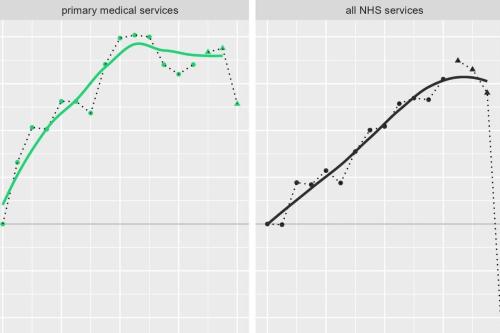
GP Practice productivity, efficiency, and continuity of care
MDSN: Long-term trends in GP practice Consultation Rates
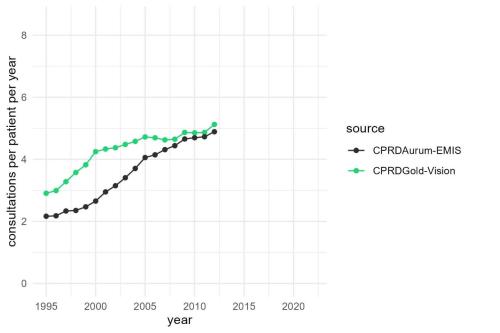
GP practice consultations are, by some distance, the most common interaction between the NHS and the population it serves.
MDSN: The gap between need and supply of GP practice consultations
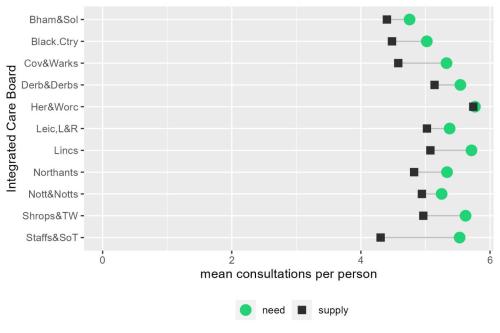
The gap between need and supply of GP practice consultations

Review of Ophthalmic Managed Clinical Networks (MCNs) in Staffordshire and Shropshire
The aim of the MCNs is to bring together primary care optometrists with local ophthalmologists within a geographical area. This is a review Strategy Unit were commissioned by NHS England to work with a medical retina MCN in Shropshire, Telford and Wrekin and a glaucoma MCN in Staffordshire and Stoke on Trent, to review their work so far and look at the opportunities the networks present.

Learning about what works in urgent community response
The initial report from the national urgent community response (UCR) evaluation, along with an economic modelling tool to help service providers and systems understand the impact of UCR, is now available.

Socio-economic inequalities in coronary heart disease
There are substantial differences in mortality rates from cardiovascular disease between socio-economic groups. Our new tool provides an overview, for ICBs, of the points on the care pathway where inequalities emerge and are amplified
Urgent Community Response – What Works?
The Strategy Unit, with our partners Ipsos, has been commissioned by NHS England and NHS Improvement (NHSEI) to provide a long-term national evaluation of the Urgent Community Response programme rolled-out across England. The programme aims to shift resources to home and community-based services as part of the NHS commitment to providing the right care, to the right people, at the right time. And there are a range of outputs from the early work that provide learning for local systems as they develop their services.

Bringing patient flow modelling into general practice
With general practice appointments hitting the highest numbers on record (34.8 million in England alone in November 2021), careful organisation and planning for patient appointments is increasingly important.

What do we know about the benefits of digital social care records?
The pace of change in the development and use of digital technology is astonishing. The use of such technology has been an essential element in the health and care services response to the COVID-19 pandemic. In many cases, the previously unthinkable became commonplace.