Some descriptions of healthcare seem to be taken straight from the film Minority Report. The 10 Year Plan for Health, for example, suggests that a combination of genomics, new diagnostics and predictive analytics with AI:
“…will mean the NHS of the future will proactively maintain wellness, identifying and mitigating disease risks years — even decades — before symptoms arise. It will also equalise access to knowledge to help empower citizens to make healthy choices… Patients will be able to view a complete account of their risk of major conditions and manage their personal health risks…”
Stopping just short of pitching Tom Cruise as a Predictive GP, this vision has many compelling elements. It extends and applies knowledge to prevent illness and improve the human lot. Science fiction guides science practice; lives improve as a result.
One criticism of this vision is that it overlooks the present. Exciting descriptions of mitigating disease decades before symptoms become apparent runs the risk of ignoring today’s woes. Before setting off to prevent the problems of potential patients, shouldn’t we diagnose and treat those who are already suffering?
I was reminded of these debates when reading our analysis for the Health Foundation ‘discharged without a diagnosis’. The analysis asks: why do some patients leave hospital after an emergency admission without receiving a formal diagnosis?
The results are fascinating. And they jar with the ambitions of applying ever-more refined data and knowledge to make precise predictions of the future. I kept coming back to the same question: why do we know so little?
The analysis describes a surprisingly sizable group of patients, who are already ‘in the system’. And there are good reasons to suspect that this group harbours serious problems. These are people with symptoms that have not been managed by themselves or other services, that have arrived at hospital in an emergency, and where a decision to admit them has been taken by clinicians who are well used to managing risk.
Readers wanting detail are kindly referred to the analysis itself, but the headlines are that:
- There were 6.5 million emergency hospital admissions in England in 2023/24. Most hospital beds were occupied by people admitted as emergencies, rather than as elective patients.
- Emergency admissions are more common in the very young and very old. And these admissions occur more frequently - at any given age - amongst people living in the most deprived parts of the country.
- Roughly 1 in 6 patients admitted in an emergency were discharged with a non-specific diagnosis. Their records contain observed ‘signs and symptoms’, but no final diagnosis.
- This is a significant level of activity in an already highly stressed system: in 2023/24 it represented 1.08 million hospital spells, or continuous stays in hospital.
Findings like this trigger multiple questions. Were these admissions necessary, or could they have been prevented? Once in the system, were there missed opportunities for better diagnosis and treatment? Are there opportunities to improve outcomes and resource use? What would we have to do if so? (etc).
And yet very little research attention has been directed towards these questions. Our analysis includes a short summary of the literature, but the stand-out finding is that – considering the sizable number of patients involved - very little has been done.
The Irony Department appears to have been working overtime: we are failing to diagnose the problem of non-diagnosis.
We did not aim to address all questions, but we could see ways of making progress. We took steps to further understand this group: what characterises people discharged without diagnosis? And – drawing on a small number of interviews with clinicians - could we advance some tentative hypotheses to explain any patterns in the data?
The two main findings here were that:
- Sex mattered
Women were more likely than men to be discharged without a diagnosis. Patterns across the life course differed, and women were more likely to be discharged without diagnosis in two age groups: 14 to 23 years and 40 to 50 years. Possible explanations here included medical misogyny, higher levels of health seeking behaviour amongst women, and menopause-related symptoms.
- Ethnicity mattered too
The effect of ethnicity was not as pronounced as for sex, but we found that people from Pakistani and Bangladeshi ethnicities were more likely to be discharged without a diagnosis. Explanations here included language barriers, cultural disconnects between patient and clinician, and whether discharge thresholds may be lower where family support was present.
There were other, more detailed, findings. For example, we found that patients admitted out of hours and on weekends were less likely to be discharged without a diagnosis than those admitted during the day / on a weekday. We also found that, although more likely to be admitted as an emergency, people from more deprived areas were no more likely to be discharged without a diagnosis than people from less deprived areas.
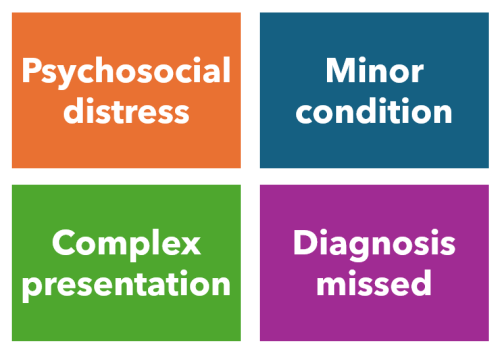
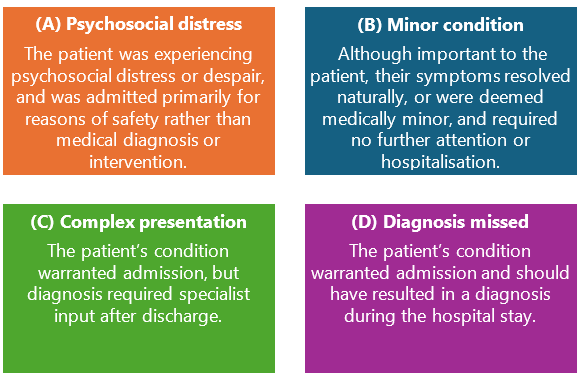
And finally, recognising that the group of patients leaving hospital without a diagnosis is not homogenous, we suggested four categories to help break down patient needs – which researchers and services could use to gain traction on this topic.
In Minority Report, it becomes clear that trying to predict and control the future is anything but a panacea. This realisation shows that the way to a better future is by addressing current problems. Maybe - in far less dramatic fashion, and minus the star quality of Cruise - our analysis is pointing to something similar?
While certain strands of policy emphasise the need for better prediction, this analysis highlights something different: a sizeable, present-day problem, where progress depends upon further analysis and insight.
Non-diagnosis confronts us with what we don’t know. This is uncomfortable. But this is not just a gap in knowledge: it is also an overlooked seam of insight.