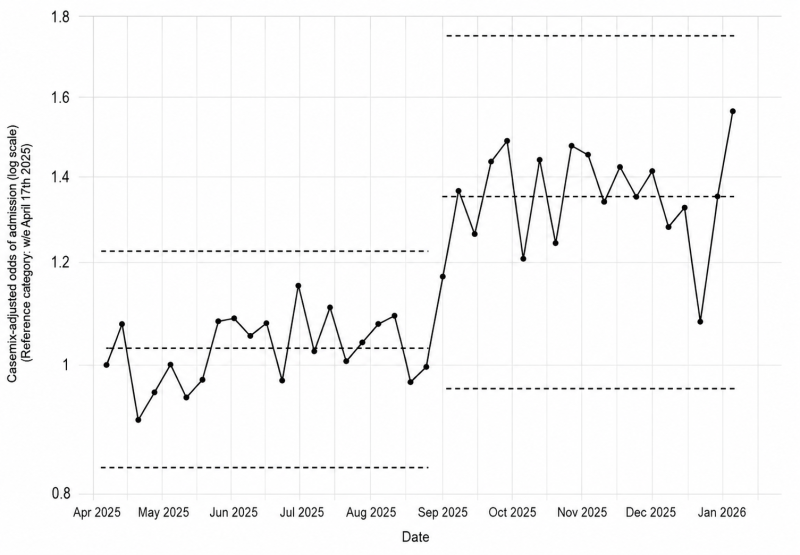
Most patients who are admitted to hospital in an emergency will have first passed through an Emergency Department (ED). For every ED patient, a clinician must decide whether admission is necessary. Clinical need should dominate that decision - but there's good evidence that factors such as a patient's social circumstances, a clinician's risk tolerance, and the availability of inpatient beds all play a part.
Combine these individual decisions across a department, or across the country, and you get an effective threshold for admission: in general, how ill do ED patients need to be before they're admitted?
This threshold has implications for the left shift – moving more care out of hospital and into community and other settings. If out-of-hospital services succeed in freeing up hospital capacity, and capacity influences admission decisions, then thresholds could quietly fall. In that case, beds freed by left-shift initiatives could be filled by patients who would not otherwise have been admitted. Gains in capacity would be neutralised, more or less.
This report examines the idea of an admission threshold and sets out how it might be estimated from routine data. The report goes on to examine how admission thresholds have changed in recent years and assesses the feasibility of monitoring thresholds in more than 170 Type 1.
The aim is not to propose a target admission threshold but to develop a way to understand how the relationship between patient need, admission decisions, and available capacity changes by department.