
The hidden challenge at the heart of the 10-year plan
A new tool exploring why hospital bed pressure is increasing and what this could mean for future NHS capacity planning.

Improving perioperative flow: using simulation to understand elective care pathways
Why are operations still being cancelled on the day of surgery, despite long waiting lists and high demand? The answer often lies not in a single point of failure, but in how the perioperative pathway functions as a whole.

What Helps People Stay in NHS Talking Therapies? Insights from Services
How NHS Talking Therapies services are improving engagement through clearer expectations, flexible access and stronger support, and what further action could enhance recovery for more people.

Supporting the Mayor's partnership approach to reducing health inequalities in London
Being commissioned by the Mayor of London to produce independent reviews of proposals for major service change, affecting Londoners, perfectly aligns with our commitment to help the health and care system make better decisions and ultimately achieve benefits for population health and wellbeing.

Why NHS models should be built to be reused
Our Head of Simulation, Dr Lucy Morgan, recently appeared on the new podcast Inside the Algorithm, hosted by Cambridg

Planning for rising renal demand: simulating capacity across the care system
Demand for kidney replacement therapy is rising, and current capacity will not be sufficient over the next decade. This work uses simulation modelling to help systems understand future pressures and test potential responses.

Beating the backlog: Meeting the waiting list challenge
The NHS waiting list in England must halve to reach waiting time targets.

Strengthening ethnicity data across the NHS: developing the national improvement plan
Our analysis and stakeholder engagement supported NHS England to develop the national Ethnicity Recording Improvement Plan.

Hydration, UTIs and older people: learning from NHS pilots about how to improve care
Our evaluation of hydration-focused interventions for older people found promising signs of impact and highlighted the practical and systemic challenges of delivering and sustaining change.
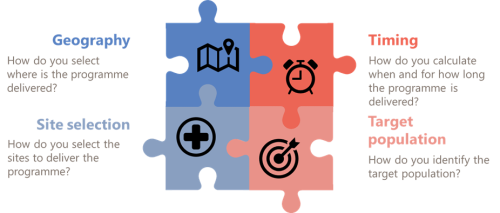
Why can’t I prove my programme is effective?
Evaluation blog series continues with Impact Evaluation Lead Mike Woodall looking at how programme designers can maximise the chances of success.
Urgent Community Response – What Works?
The Strategy Unit, with our partners Ipsos, has been commissioned by NHS England and NHS Improvement (NHSEI) to provide a long-term national evaluation of the Urgent Community Response programme rolled-out across England. The programme aims to shift resources to home and community-based services as part of the NHS commitment to providing the right care, to the right people, at the right time. And there are a range of outputs from the early work that provide learning for local systems as they develop their services.

Some positive news for integrating GP practices with hospital trusts
The drive for greater integration of health and care services has been the central theme of UK health policy for most of
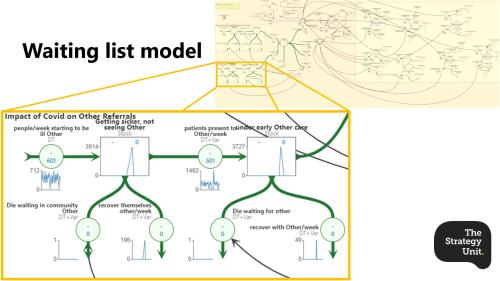
Modelling the impact of covid on waiting lists for planned care
Working with the national collaboration to coordinate covid-related analysis, and the NHSE/I Midlands region, the Strategy Unit has produced a ‘systems dynamics’ model of waiting lists for planned care. The model is freely available for non-commercial use across the NHS. Here, Steven Wyatt and Mike Woodall explain what we did and how we did it.