
Despair now accounts for one-sixth of all years of life lost
Deaths from drug misuse, alcohol use and suicide, often referred to as deaths of despair, are on the rise. New research, by the Strategy Unit and the Health Foundation, show how deaths rates vary by sex and socio-economic deprivation, and how these rates changed during and after the COVID-19 pandemic.
Neighbourhoods and hospital activity: oh yes it can, oh no it can’t?
Simple, intuitive ideas don’t draw critical attention. They stroll about the policy world, untested and unscathed.

Exploring cultural adaptations in dementia care: our work with the NHS Race and Health Observatory
Understanding what it takes to deliver culturally responsive dementia care.

Improving perioperative flow: using simulation to understand elective care pathways
Why are operations still being cancelled on the day of surgery, despite long waiting lists and high demand? The answer often lies not in a single point of failure, but in how the perioperative pathway functions as a whole.

Neighbourhood health should not be judged (solely) by its ability to reduce hospital activity
In 1962, President John F. Kennedy arrived at NASA headquarters for a progress update on the planned trip to the moon.

Diagnosing the problems of non-diagnosis
Some descriptions of healthcare seem to be taken straight from the film Minority Report.

Continuity in primary care: the safest bet we aren’t able to make?
In this long-read, which first appeared in the HSJ, Fraser Battye asks whether focusing on continuity might also improve access to primary care

What explains the recent growth in hospital activity?
In this long read, Fraser Battye describes our analysis of what has driven the growth in hospital activity.

A journey into intersectionality
A practical exploration of intersectionality, testing theory through quantitative analysis of hospital readmissions.

The enduring ‘messy programme’ with ‘mixed results’
The diagram below shows me at my most cynical.

Beating the backlog: Meeting the waiting list challenge
The NHS waiting list in England must halve to reach waiting time targets.

Strengthening ethnicity data across the NHS: developing the national improvement plan
Our analysis and stakeholder engagement supported NHS England to develop the national Ethnicity Recording Improvement Plan.

A fairer funding future for general practice: lessons from Leicester, Leicestershire and Rutland ICB
Our evaluation of the Health Equity Payment (HEP) scheme in Leicester, Leicestershire and Rutland highlights how flexible, needs-based GP funding can support more equitable care.
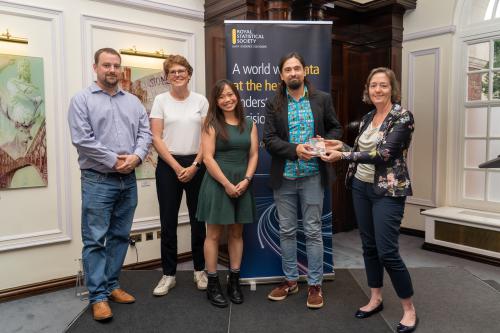
Strategy Unit demand model wins prestigious Florence Nightingale Award
Our open-source demand model, developed in collaboration with the New Hospital Programme, has been named the 2025 winner of the Florence Nightingale Award for Excellence in Health and Care Analytics.

Virtual wards: Patient and unpaid carer experiences of ‘hospital at home’ care
Our evaluation of patient and carer experiences of virtual wards found widespread benefits and highlights areas for improvements parti

Scoping a Health Needs Assessment for Adults on Probation in England
This scoping report explores the health inequalities experienced by people on probation and the limited data on their health needs and engagement with health services. It sets out recommendations for commissioning and delivering a national health needs assessment to address that data gap and support local health needs assessments for the probation population.

Transforming Hospital Planning with an Open-Source Demand and Capacity Model
We are proud to announce the open-sourcing of a demand and capacity model, developed with the New Hospitals Programme, to transform NHS hospital planning with transparency, collaboration, and efficiency.

Our role in the New Hospital Programme
Learn how the Strategy Unit’s innovative model is transforming hospital planning by providing a consistent, data-driven approach to forecast future demand and evidence-based decision making.

‘Internal Consultancy’: INSIGHTS from evidence and experience
In this blog, our Head of Policy, Fraser Battye, shares his reflections on a recent ‘SU INSIGHTS’ event on the ‘Internal Consultancy’

From ‘right drift’ to ‘left shift’?
Our Head of Policy, Fraser Battye, looks at the challenges facing the intention to shift care ‘from hospital to community’. He suggests that we have missed a critical part of the explanation for why this ‘left shift’ hasn’t taken place following previous initiatives.