
Infant feeding problems, lockdown and attendance at Emergency Departments: what’s going on?
From our previous work, with Nuffield Trust and Health Foundation, we know that lockdown had a significant effect on attendance at Emergency Departments (ED). We also know that this effect was very unevenly distributed: some demographic groups stayed away far more than others.

Decisions to admit patients are not solely determined by clinical risk
Whether or not to admit a patient is one of the most routine yet important decisions a doctor in an Emergency Department

Less noise and more light: using criteria-driven analysis to tackle inequalities
Reducing health inequality is a long-standing aim of health policy. Yet the gap between policy aim and population outcome has grown in recent years: on most measures health inequalities have got worse.

A framework for understanding policy change
A new policy, strategic direction or major programme is announced.

Localism and the NHS: a case in four stories
In this blog, Fraser Battye makes the case for localism in the NHS. He tells four short stories. He suggests that these stories highlight an opportunity as the NHS enters a period of reform.

Learning from lockdown: support for people experiencing homelessness
There are few clearer measures of societal health than homelessness.

Strategy Unit analysis published showing changes in use of emergency departments under lockdown
We know that patterns of access to healthcare have changed during the pandemic.

Is ‘Integrating Care’ bold enough?
In this blog, Fraser Battye leaves the Strategy Unit’s usual careful and empirical view of the world. He reflects on NHS England and Improvement’s ‘Integrating Care’ paper from the perspective of wider ideological and societal trends. In doing so, he suggests that there is scope for bolder reform – and that localism is the way to go.

What might ‘Integrating Care’ mean for analysts?
In this blog, Fraser Battye looks at NHS England/Improvement’s ‘Integrating Care’ paper. While not looking forward to another NHS re-organisation, he sees a lot that analysts will like. Fraser also notes the potential advantage that the Decision Support Unit model gives systems in the Midlands. What can analysts do to seize these opportunities?

Evaluating Artificial Intelligence: a significant new win
The Strategy Unit, the Health Economics Unit and Leicester Clinical Trials Unit have been announced as evaluation partners to support success in the Artificial Intelligence (AI) in Health and Care Awards.
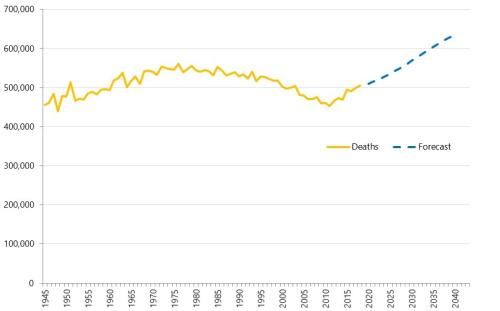
Health service use in the last two years of life
Health and care services get just one opportunity to support people at the end of their life. When this support is compassionate and appropriate, unnecessary suffering can be avoided and grieving can be eased. When this is not the case, harm and distress can result. The difference in these experiences can be profound.

Bringing NHS analytics into the 21st Century
A marriage usually needs (at least): a matchmaker, two entities, a (little) money, a proposal and a home.
How can Integrated Care Systems collect and use more ‘person-centred intelligence’?
Working with our partners
Midlands Population Health Management Academy
The Midlands Population Health Management Academy was part of a programme of support, commissioned by NHS
Lessons, Evaluation and Learning from the Dudley MCP
Learning from Dudley MCP
The Strategy Unit have been awarded funding from the Health Foundation to continue promoting the use of R in the NHS via the NHS-R Community
The value of R and its use within the NHS
PHM Core Team - 2nd July 2019
PHM Academy - Core Team Event 2nd July 2019 We held our first Core Team event on the 2nd July 2019 which was a huge success.
Population Health Management Analyst Development Programme: An overview
The Population Health Management (PHM) Analyst Development Programme will introduce analysts from the Midlands CCGs, NHS Trusts, CSUs, Local Author