
The enduring ‘messy programme’ with ‘mixed results’
The diagram below shows me at my most cynical.

Strengthening ethnicity data across the NHS: developing the national improvement plan
Our analysis and stakeholder engagement supported NHS England to develop the national Ethnicity Recording Improvement Plan.

10-Year Productivity Forecast for the English NHS: An Expert Elicitation Study
Expert elicitation exercise commissioned by and in collaboration with the Health Foundation has produced forecasts of NHS productivity rates over the next 10 years.

Cancer and comorbidities: An Evidence Review of Diagnosis, Treatment, and Experience
An evidence review on the challenges and disparities faced by individuals living with cancer alongside other long-term conditions.

Hydration, UTIs and older people: learning from NHS pilots about how to improve care
Our evaluation of hydration-focused interventions for older people found promising signs of impact and highlighted the practical and systemic challenges of delivering and sustaining change.
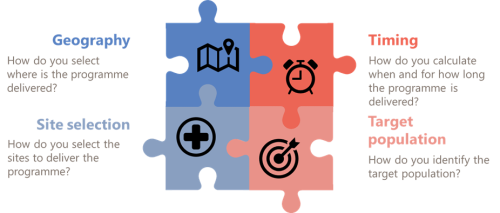
Why can’t I prove my programme is effective?
Evaluation blog series continues with Impact Evaluation Lead Mike Woodall looking at how programme designers can maximise the chances of success.
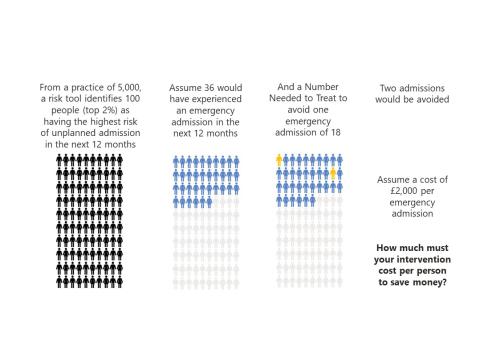
‘To risk stratify or not risk stratify, that is the question’ (At least, it should be)
Risk stratification tools are ubiquitous in healthcare. The concept is simple and seductive.
Urgent Community Response – What Works?
The Strategy Unit, with our partners Ipsos, has been commissioned by NHS England and NHS Improvement (NHSEI) to provide a long-term national evaluation of the Urgent Community Response programme rolled-out across England. The programme aims to shift resources to home and community-based services as part of the NHS commitment to providing the right care, to the right people, at the right time. And there are a range of outputs from the early work that provide learning for local systems as they develop their services.

Advancing the analytical capability of the NHS and its ICS partners
The Strategy Unit were asked by the Strategy and Development Team in the Directorate of the Chief Data and Analytics Officer, NHSE/I, to make recommendations for advancing analytical capability across the health and care workforce.

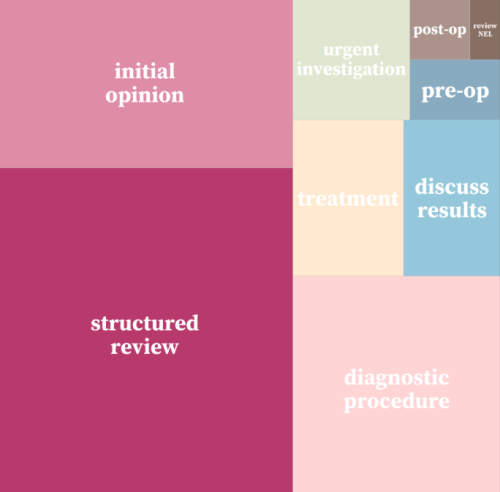
Strategy Unit devises a new method for classifying outpatient appointments
The number of outpatient attendances in England is now approaching 100 million each year.

Decisions to admit patients are not solely determined by clinical risk
Whether or not to admit a patient is one of the most routine yet important decisions a doctor in an Emergency Department

Learning the lessons of Long Covid in real time
Round table event, 12 July

Reviewing the evidence on digital inclusion
Digital technology is a significant part of our daily&nb

Evidence review: Early diagnosis of cancer
Detecting cancers early is essential to saving lives and reducing the need for invasive treatments.

Some positive news for integrating GP practices with hospital trusts
The drive for greater integration of health and care services has been the central theme of UK health policy for most of

Strategy Unit analysis published showing changes in use of emergency departments under lockdown
We know that patterns of access to healthcare have changed during the pandemic.

Evaluating Artificial Intelligence: a significant new win
The Strategy Unit, the Health Economics Unit and Leicester Clinical Trials Unit have been announced as evaluation partners to support success in the Artificial Intelligence (AI) in Health and Care Awards.

Making sense of evidence
It's time to celebrate World Evidence-Based Healthcare (EBHC) Day. In a world dominated by COVID-19 and the associated infodemic, this day arguably has more resonance. Closer to home, EBHC Day also coincides with our Insight 2020 festival and the launch of the Midlands Decision Support network. What better opportunity to ask, 'what does evidence-informed decision making actually mean'?
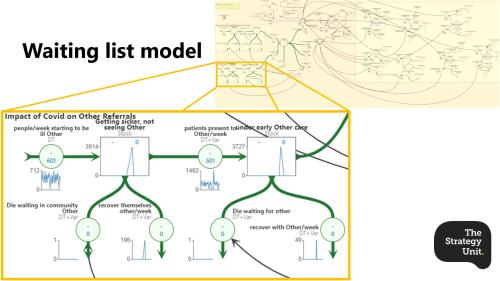
Modelling the impact of covid on waiting lists for planned care
Working with the national collaboration to coordinate covid-related analysis, and the NHSE/I Midlands region, the Strategy Unit has produced a ‘systems dynamics’ model of waiting lists for planned care. The model is freely available for non-commercial use across the NHS. Here, Steven Wyatt and Mike Woodall explain what we did and how we did it.